CPU 10
It was never meant
to be polite.
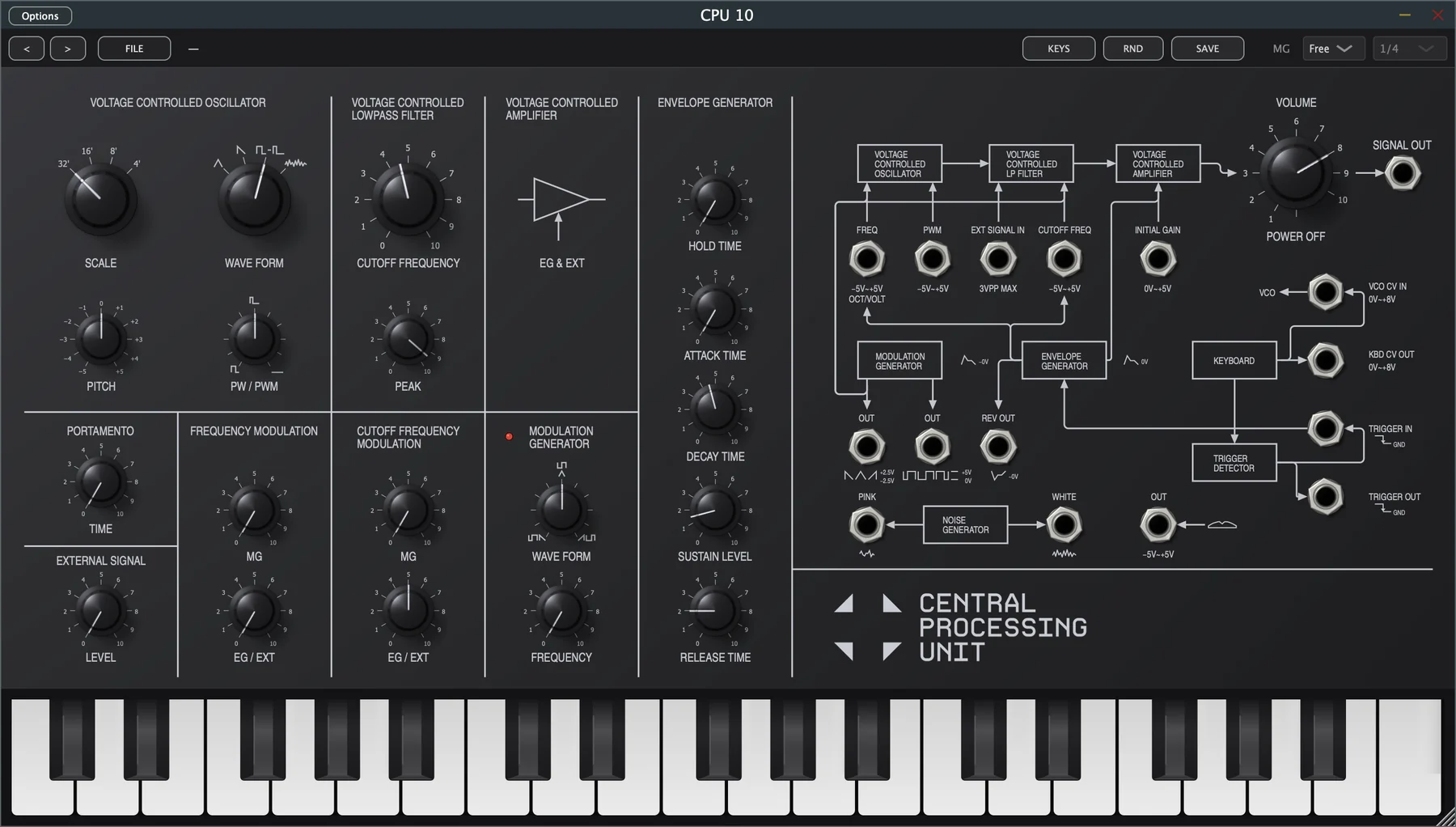
An emulation of the MS-10, the 1978 monophonic synthesiser: one oscillator, a two-pole lowpass, a five-stage envelope and a patch panel that lets you rewire the lot. Built from the service-manual circuit, component by component, so it holds up however you patch it. In testing, not yet released.
- Voice
- Monophonic - semi-modular One oscillator, four waveforms (triangle, sawtooth, pulse with PW/PWM, white noise).
- Filter
- 2-pole, 12 dB/oct A KORG 35 lowpass that self-oscillates into a clean sine.
- Platform
- macOS · Windows · Linux VST3, AU and standalone on macOS. VST3 and standalone on Windows. VST3, LV2 and standalone on Linux.
- Availability
- In development Fully functional and in testing. Not yet released.
A filter with a dirt of its own
Twelve dB an octave, where most synths give you twenty-four. That is not a milder filter, it is a different one: it keeps the body in the sound as it closes, so a bass thickens instead of thinning out and a lead stays present with the tone right down.
The distortion is the other half of it, and it is built into the signal path rather than bolted on. The parts that clip sit in the main path, so pushing the level dirties the whole sound at every frequency, not just around the corner. The resonance is lopsided, leaning harder on one half of the wave than the other, which is where the growl comes from. Push the peak far enough and it breaks into a clean, singing sine.
CPU 10 takes all of that from the circuit, not from a stock filter with the numbers changed.
The patch panel is the instrument
Sixteen jacks down the right-hand side, with the signal path drawn on the panel beside them so you can see what you are interrupting. Take the envelope somewhere it was never meant to go, run an external signal through the filter, or drive the pitch from the modulation generator - which gives you a triangle and a rectangle at once, sweeping between shapes on a single control.
The original speaks its own language: pitch as doubling volts rather than one volt an octave, and a trigger that works by shorting rather than by going high. CPU 10 keeps that behaviour rather than quietly modernising it.
Modern extras, authentic by default
Factory presets and user presets, with a name readout and a save that asks before it overwrites. A randomiser you can press again and again and still get back to where you started. An on-screen keyboard you can hide when you want the panel. A modulation generator that locks to your tempo if you want it to. And every knob sits on a MIDI CC, so a controller drives the panel directly.
All of it sits on a strip above the modelled panel, so the authentic behaviour is always what you get by default.
Support and enquiries: input (at) cpurecords.net